A board that samples once an hour is idle for fifty-nine minutes. Those minutes
are enough to answer questions about data already on disk. This chapter is the
engine that spends them: skills/research_agent.
It is domain-neutral. It knows about questions, analyses, findings, verdicts and watches, and nothing about what the numbers mean.
What happens between measurements
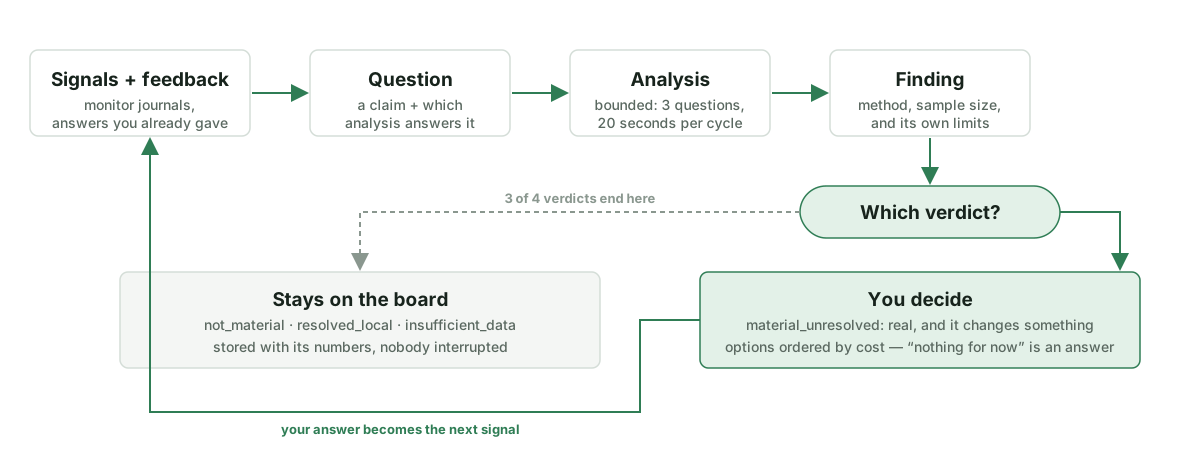
Three properties make this research rather than alerting:
- The question exists before the answer, and is stored with its provenance.
- The method, sample window, and observations are retained with the conclusion.
- A negative result remains available for review without becoming an alert.
Where questions come from
Signals. A scan reads the tail of each monitor journal and looks for shapes worth a closer look: a source that stopped reporting, a level that moved beyond its own noise, a channel piling up against a limit. The scan concludes nothing; it raises a question and hands it to an analysis.
Human feedback. Two refusals on the same subject are not stubbornness. They are evidence that the board is asking the wrong question, or asking it too often, so the engine opens a question about its own alerting threshold.
Packs. A domain declares the questions it always cares about. See chapter 8.
The shapes it looks for
Every analysis is a shape in the data. These six are the core pictures; learn them and you know most of what the board can notice on its own.
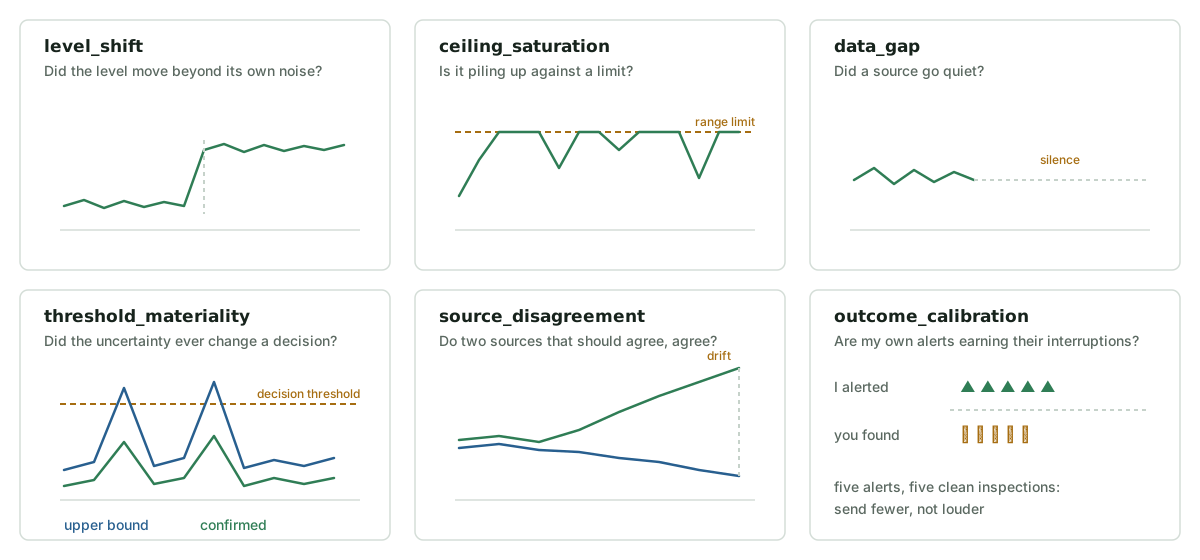
| Analysis | Question it answers |
|---|---|
level_shift |
Did the level move beyond its own noise? |
ceiling_saturation |
Is a channel piling up against a limit? |
data_gap |
Did a source go quiet? |
threshold_materiality |
Did the uncertainty ever change a decision? |
source_disagreement |
Do two sources that should agree, agree? |
outcome_calibration |
Are the board's own alerts earning their interruptions? |
neighbour_reports |
Do nearby reporters see something this board does not? |
baseline_deviation |
Is the current period unlike the periods before it? |
lagged_association |
Does one series move before another, by a fixed number of days? |
relationship_forecast |
A confirmed relationship's driver ran high: what would it imply, and when? |
coverage_gaps |
Which questions has the board framed that nothing here can measure? |
Three of these are what a networked board with a weather history is for.
neighbour_reports reads confirmed reports from other boards with their
distance and asks whether the local indicator agrees. A confirmation two
kilometres away raises the prior here and earns one cheap local check, nothing
more. source_disagreement between a weather forecast and what the station
later measured answers whether the forecast driving a risk projection can still
be trusted. baseline_deviation asks the question a person actually asks about
weather: not "is it warm" but "is this season unlike the last several".
Forming a hypothesis nobody wrote down
Everything above answers a question somebody registered. That makes the board a
scheduler for a research catalogue: useful, but not a scientist. The step
across is schema discovery plus lagged_association. A domain pack points to
an evidence store. It does not list expected variables, divide the clock into
named agronomic periods, or prescribe candidate relationships.
For each SQLite table the engine infers a parseable temporal axis, changing numeric columns, and repeated entity dimensions from cardinality and table keys. Numeric JSONL channels are discovered in the same way. Every channel is eligible to lead or respond. If a channel is subdaily, cyclic windows are generated from its observed clock coverage and retained as hour ranges. A surviving window may later be interpreted by a domain adapter, but the search does not begin with words such as night, humidity, disease, camera, or sensor.
This lets a newly connected instrument enter discovery without a source-code change when it writes identifiable, timestamped observations. Forecasts and simulated outputs remain distinct from measured responses. Model diagnostics use their separate analyses; ambiguous tables can declare their time axis, entity keys, and evidence origin in the pack.
Testing a Candidate Relationship
A generator that proposes relationships will find them in randomness unless every guard pushes toward the negative:
- the test runs on first differences to reduce shared-trend effects;
- the effect must persist in both halves of the record with the same sign;
- significance is corrected jointly for generated clock windows and lags;
- a floor of 30 overlapping days and a minimum effect size;
- a refuted pair stays refuted and is never proposed again.
Synthetic tests exercise independent noise, known leads, missing dates, and observation/forecast separation. Pair discovery is budgeted at two new pairs per cycle. The stored method and sample window make each result inspectable.
It reports precedence, never causation. The question it asks is whether the driver acts on the response, or both follow something else.
Keep Investigation Running
Install the recurring research service on a general Linux host, or use the bounded executor task on a board. The research service does not depend on a vineyard application or messaging account.
Queued studies run before expensive discovery scans. A reserved slot goes to an untested discovery, so recurring high-priority checks cannot consume every cycle. A file that has not changed can still contain unanswered questions: the engine continues that backlog before returning to quiet, no-write cycles.
Use research-agent mode=findings to read conclusions and mode=questions to
inspect what has actually run. Telegram delivery is a separate application
step. The adapter interprets a relevant finding in the user's language; raw
question counts and software diagnostics stay in the local record.
Confirming is what starts a study
A pattern found in the record that produced it has been described, not confirmed. So the first option on a hypothesis is not "act on it" but "shall I test it properly?", and accepting it drafts a prospective study:
- id: study_lagged_association_1
  name: "Prospective check: channel A precedes channel B"
  status: template          # the executor does not run a template
  steps:
    - id: measure
      action: call_skill
      parameters:
        skill_name: research_agent
        mode: investigate
        question_id: 1
      repeat:
        interval_sec: 604800
        max_iterations: 8
        journal_path: /tmp/monitors/study_lagged_association_1.jsonl
Re-running the same question weekly on data collected after the hypothesis was formed is the cheapest honest experiment, and it needs no new hardware.
The draft is written as status: template, which the executor ignores.
Promoting it to pending is a human act. The board proposes an experiment; it
does not start one, and the skill name is validated and the repeat bounds
clamped before anything is written.
When evidence is incomplete
A discovered pair can still return insufficient_data when fewer than 30
overlapping days remain after gaps and lags. That is a property of two series
the board actually holds. The engine does not manufacture an absent response
channel or ask a person to collect a preselected measurement. Coverage gaps are
reported separately from the open questions already present in evidence.
From understanding to anticipation
A relationship the board found and a person confirmed can be pointed forwards. The driver is watched; when it runs unusually high, the board reports the observation and what it would imply:
Channel A crossed its local high threshold on 2026-08-08. By the relationship
confirmed for this apparatus (rho 0.958 over 146 days), that would point at a
change in channel B around 2026-08-11: a projection of that relationship, not
a measurement.
The finding is still an observation first. The projection follows only when there is a basis for it: below rho 0.5 or 60 observed days the board keeps relating the two facts and says nothing about the future. Understanding is a legitimate place to stop, and an unfounded prediction is worse than silence.
Two further guards: the driver must cross the 95th percentile of its own history, since a threshold crossed one day in five warns about nothing; and the predicted day must still be ahead, because a warning that arrives on the day it predicts is news about the past.
Attending to what is missing
Every analysis so far studies evidence that exists. coverage_gaps studies its
absence: it gathers the questions the board has framed and could not run,
groups them by the measurement each needs, and reports the register once.
3 missing measurements. The most useful would be insect counts:
it would let me answer 2 questions I cannot answer now.
Once, not per blocked question. A board that repeats "I cannot test this" every cycle has turned a gap into nagging. A gap describes the board's instruments, not the field, and adding a measurement makes a question testable rather than making its answer positive.
Drafting a published model as a skill
Research sometimes finds a model in the literature that this board does not
have. It may be written down as a candidate skill, with sources attached and
only after a person agrees. The manifest carries status: draft,
requires_validation: true, its sources, and the checks it must pass, and it
lands where nothing discovers it as a capability.
The route refuses without a published source: a model nobody has written down is a hypothesis, and this is for putting literature into testable shape, not for inventing agronomy. A disease model is not a sensor driver, because its output becomes treatment advice, so validation against confirmed local outcomes and promotion stay separate human acts.
Learning what to research
The board keeps a record of what its own research has been worth. An analysis with no material finding after six attempts is demoted; one whose findings the human keeps declining is demoted too, because that is evidence about the question rather than about the human; a productive one gains a little.
Demoted, never silenced: an analysis that stops running can never earn its place back, so the penalty is bounded and the floor is one.
Two boards do not have the same questions worth asking, and only a board's own record can say which it is.
Reusing a skill instead of reimplementing it
A board that already has a skill for seasonal averages should not have that
arithmetic written again inside an analysis. A source can name an installed
skill, or a glob of the artifacts a skill wrote, and any source may carry a
refresh that runs first:
{"kind": "glob", "pattern": ".../results/season_climate_*_*.json",
 "refresh": {"kind": "skill", "name": "vineyard_season_climate",
             "params": {"mode": "report", "write_artifacts": true}}}
Vineyard Guard uses this separation in two complementary ways.
vineyard-season-climate writes human-readable annual artifacts and a daily
SQLite matrix of 18 unit-preserving environmental channels per field. Its EAV
adapter expands the observed field/metric dimensions, marks weather as an
environmental driver, and leaves response choice and lag discovery to the
generic engine. Disease outputs, image metrics, operations, phenology, and
fruit-composition observations can therefore become candidate responses
without adding a named agronomic correlation to the pack.
The daily deterministic refresh updates this matrix before the hourly idle research loop. A cultivar literature profile supplies source-attributed prior knowledge, but it cannot by itself release a harvest date: current local phenology and composition measurements remain necessary.
A skill-backed question sets its own min_interval_seconds; reading a season
of weather is a weekly job, not an hourly one.
Each reads a JSONL journal or a local SQLite table, so anything nora already records is a valid input. Most domain questions turn out to be one of these six wearing different words.
A worked study
Take the quickstart journal from the index and ask one question directly instead of waiting for the scan:
printf '%s' '{"mode":"investigate","state_dir":"/tmp/nora-demo/state","analysis":"level_shift","subject":"light_probe","params":{"source":{"kind":"journal","path":"/tmp/nora-demo/monitors/light_probe.jsonl"},"key":"temp_c"}}' | ./skills/research_agent/run.sh
{"status": "success", "mode": "investigate",
 "summary": [{"subject": "light_probe", "analysis": "level_shift",
              "verdict": "not_material", "sample_size": 48}]}
not_material is the answer, and nobody is interrupted by it. The stored
finding still carries the numbers that produced it:
printf '%s' '{"mode":"findings","state_dir":"/tmp/nora-demo/state","limit":1}' | ./skills/research_agent/run.sh
The metrics object holds median_before, median_after, shift,
within_half_deviation and shift_threshold. Anyone can check the reasoning
without rerunning it.
Why the spread is measured within each half
A shift detector that measures noise across the whole window is defeated by the shift itself: the step inflates the very spread it is compared against, and a real change scores as ordinary variation. The engine measures the deviation inside each half separately, so a step between two stable halves is significant no matter how large it is.
This is the kind of detail that decides whether an autonomous researcher is useful or merely busy.
Why most analyses remain quiet
| Verdict | What happens |
|---|---|
material_unresolved |
Extended locally first; handed to an adapter only when a human observation or decision remains |
not_material |
Stored and marked answered; visible in technical status, not sent to the farmer |
resolved_local |
Stored as an answer in evidence memory and the dashboard |
insufficient_data |
Stored as an internal gap; it never becomes a bulletin or task for the human |
An analysis that could not run is not a discovery. A board that lacks the data to check something must not convert its blind spot into a request for attention, budget, or hardware.
Research bookkeeping stays in the technical dashboard. The proactive adapter does not send hypothesis counts, source-audit summaries or unfinished-analysis counts to the farmer.
Vineyard deployments instead produce a separate field_condition_result at
most once per six days. It reads fresh observed seasonal-climate artifacts and
answers an agronomic question: what rain, heat, night temperature, humidity and
solar exposure the vines experienced; how the latest 30 days differ from the
preceding month and the matched prior-year period when coverage permits; and
which berry measurements are needed before making a claim about ripening,
acidity or harvest readiness. This applied synthesis is independent of the
generic research engine.
Budget
One cycle is bounded by questions, seconds, files and lines:
{"mode":"cycle","max_questions":3,"max_seconds":20,"max_files":12,"max_lines":400}
tasks/029_autonomous_research_cycle.yaml runs one every fifteen minutes and
journals the result. The defaults are sized so the research never competes with
sampling on a 256 MB board.
Asking, and not insisting
A finding that reaches a human arrives with its numbers, with options ordered by cost, and with "nothing for now" as a legitimate answer. The engine records the reply:
printf '%s' '{"mode":"record_decision","state_dir":"/tmp/nora-demo/state","finding_id":1,"decision":"accepted","option_id":"check_source","watch":true,"note":"probe is capped at 100"}' | ./skills/research_agent/run.sh
An acceptance may arm a watch: a future action a human confirmed once. When the same pattern returns, the watch fires and disarms. A refusal closes the question for the season instead of rescheduling it, because "no" is an answer.
Hardware is never the first way to close a question, and never the only one. A suggestion to buy something belongs at the end of a list whose first entry is free, and it is not repeated after a refusal.
Failure as diagnostic evidence
A failed or partial task run is excluded from advice, but it can open a narrow investigation:
Observed failure:
  sensor skill returned no device identity after two bounded attempts

Research question:
  which SG2002 I2C bus and voltage constraints apply to this sensor family?

Next experiment:
  read-only bus discovery followed by identity-register validation
The original failure is preserved, and a web answer never becomes a local success.
When local evidence is not enough
An external search is for the question the local analysis could not settle, and it asks the scientific question. "Is a 95% humidity threshold a validated wetness proxy?" is research. "Which humidity sensors should I buy?" is shopping. Source-attributed results become candidate evidence for review, never instructions, product selections, or confirmed facts.
Model learning remains separate
Application models have their own training data, fitted parameters, evaluation, release status, and version. Neither a promoted skill nor an LLM explanation is a trained scientific model, and neither is a finding. This distinction matters when boards exchange model deltas or when a fallback model is used before enough confirmed local labels exist.